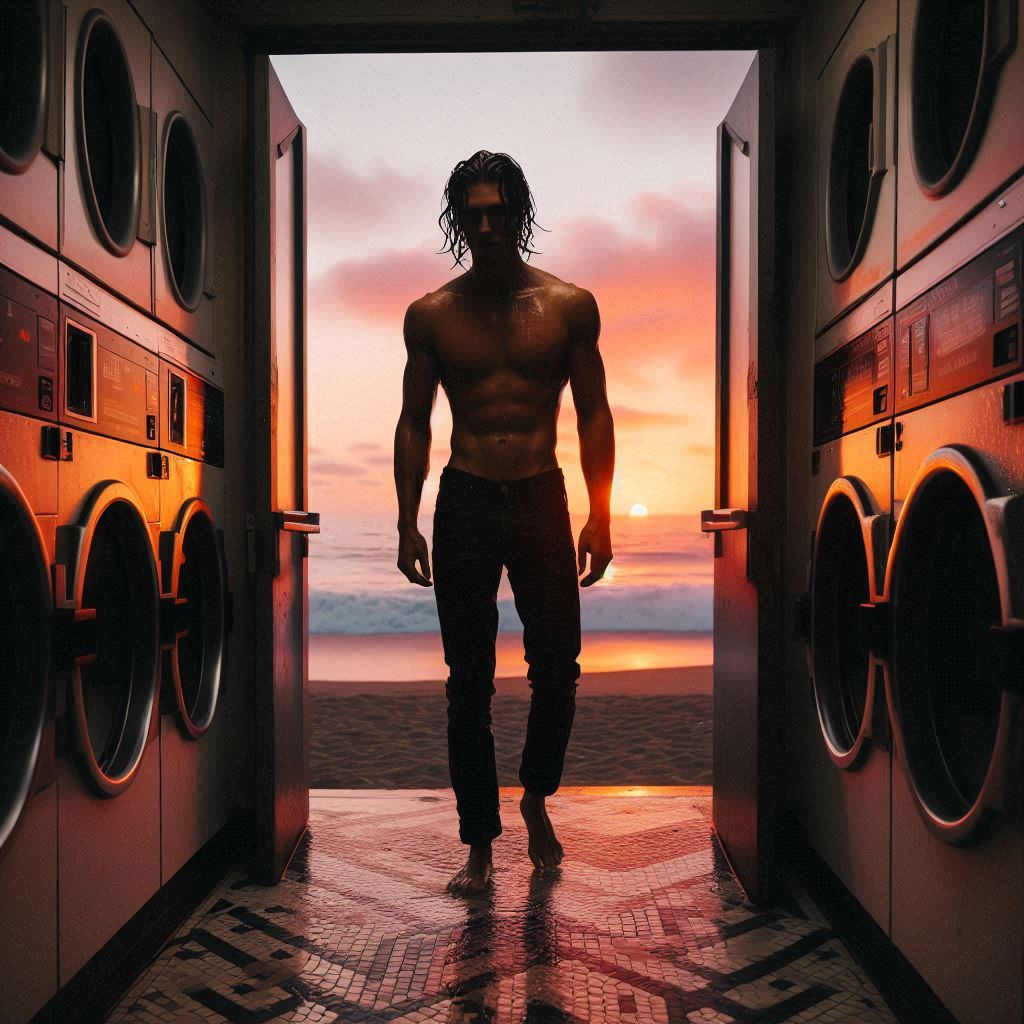
Lila saw the lights first.
Not the girl. Not the boxes. Not the moving truck with the mainland rental sticker still half-peeled from the bumper like a bad sunburn.
The lights.
At six forty-three in the morning, when the island was still soft around the edges and the tide was pulling itself back from the shore, the old laundromat across the street blinked awake.
One buzzing fluorescent strip.
Then another.
Then the ugly little beer-sign-shaped neon in the front window that said OPEN, even though the place had not been open for months.
Lila stood barefoot behind the counter of her surf shop, one hand wrapped around a mug of coffee that had gone cold twenty minutes ago, and stared through the salt-fogged front window.
“Well, I’ll be damned,” she muttered.
The Tiki Tumble had been dark since old Mrs. Alani’s daughter moved to the mainland and decided she was too good to come back and scrub other people’s sand-crusted towels for a living. Before that, the place had belonged to Mrs. Alani herself, who had run it like a church with lint traps. Nobody left clothes sitting too long. Nobody used too much detergent. Nobody washed shoes without asking first. And God help the tourist who tried to shove four beach blankets into one small washer.
Mrs. Alani had been five feet of thunder with white hair, brown hands, and a glare that could fold a man in half.
That laundromat had been hers.
It had been island hands, island work, island noise. The kind of place where fishermen washed their boat rags, mothers washed school uniforms, surfers washed towels, and tourists came in helpless, sunburned, and stupid, holding damp laundry like it was a medical emergency.
Now the lights were on again.
And Lila didn’t like it.
She took a slow sip of coffee and made a face. Cold. Bitter. Perfect.
Across the street, the front door of The Tiki Tumble opened, and a pale white woman stepped outside carrying a roll of paper towels under one arm and a bottle of blue window cleaner in her hand.
Lila’s eyebrows lifted.
“Oh,” she said to no one.
There she was.
The fucking American.
She was younger than Lila expected. Not some retired mainland woman with a visor and too much jewelry. Not some corporate little franchise princess sent to bleach the soul out of the place and rename it something awful like Spin & Shine Coastal Laundry Experience.
No.
This one looked like she had driven until the road ended and then gotten out just to prove she could.
She had pale skin that looked offended by the sun, messy hair pinned up in a way that had already given up on itself, and the kind of long, distracted limbs that made Lila think of someone who was always reaching for something and never quite getting it. She wore cut-off shorts, a loose tank top, and old sneakers. Her shoulders were pink from yesterday’s sun, maybe the day before that. She moved like she was tired but stubborn.
Lila knew that walk.
The island was full of people who arrived tired. Most left tired too.
The woman sprayed the front window, wiped three circles into the dust, then stopped and stared at the glass like it had personally insulted her.
Lila almost smiled.
Almost.
Then she remembered whose window it was.
“Don’t get cute,” she told herself.
The woman leaned forward, wiped harder, and left a giant streak right down the middle.
Lila did smile then.
Just a little.
For three days, Lila watched her.
Not in a creepy way. At least, that was what she told herself.
It was hard not to watch something happening directly across the street, especially when the something was a stranger reopening a business that had belonged to people Lila knew. The surf shop sat angled toward the laundromat, its front windows facing the row of sun-faded storefronts like a person with one skeptical eye open.
From behind her counter, Lila could see everything.
The woman hauled boxes in and out. She wrestled with a mop bucket. She dragged a rolled-up rug through the front door and nearly fell backward over it. She stood on a chair to clean the top of the dryers and almost lost her balance twice. She carried in a ridiculous number of houseplants, which seemed optimistic for a building that smelled permanently of detergent, mildew, and ghost lint.
On the second day, she painted the front door turquoise.
Lila had opinions about that.
On the third day, the woman changed the curtains in the upstairs window.
That was when Lila realized she was not just reopening the laundromat.
She was living there.
“Fantastic,” Lila said, tossing a stack of rash guards onto the counter. “The invasion has an upstairs apartment.”
The bell over the surf shop door jingled.
Lila didn’t turn around right away. She knew the sound of local footsteps versus tourist footsteps. Tourists shuffled. Locals entered like the shop owed them something.
“Morning,” called Kai, one of her father’s old surfing friends, though “old” was unfair because Kai refused to be old. His knees, however, had filed a formal complaint.
“Morning,” Lila said. “You need wax, or are you here to bother me?”
“Can’t it be both?”
“It is always both.”
Kai laughed and walked toward the counter, his flip-flops slapping against the wooden floor. He smelled like coconut sunscreen, salt, and coffee. His gray curls were tied back, his skin dark and weathered from decades in the sun, and his smile was the kind that made tourists think he was harmless.
Kai was not harmless. Kai knew everyone’s business and used that information recreationally.
He followed Lila’s gaze across the street.
“So you saw her,” he said.
Lila reached under the counter and pulled out a box of board wax. “Hard to miss.”
“Bought the place, I heard.”
“I gathered that from the boxes and the unsolicited presence.”
Kai leaned against the counter and looked amused. “You know anything about her?”
“No.”
“You want to?”
“No.”
“That means yes.”
Lila slapped the wax onto the counter. “It means no, Kai.”
He grinned. “Name’s Heidi.”
Lila hated that she immediately stored the information.
“Heidi,” she repeated, making the name sound like something she had found stuck to the bottom of her sandal.
“From Ohio, maybe. Or Pennsylvania. One of those places where people think black pepper and mayonnaise is spicy.”
Lila snorted despite herself.
Kai glanced at her. “She bought it from Alani’s daughter.”
“Of course she did.”
“Cash, I heard.”
That made Lila look at him.
“Cash?”
“That’s what Mina said.”
“Mina says a lot.”
“Mina works at the bank.”
“Mina also told everyone my cousin was pregnant because she saw her buying ginger candy.”
“She was pregnant.”
“Eventually. That is not the same thing.”
Kai shrugged. “Still. Cash.”
Across the street, Heidi came back outside with a broom and began sweeping the sidewalk in front of the laundromat. She was terrible at it. She swept dirt into a pile, then accidentally kicked the pile apart with her own foot.
Lila watched with the grim fascination of a person witnessing a small private disaster.
Kai followed her gaze again.
“She’s pale,” he said.
“She’s American.”
“You’re American too, technically.”
Lila shot him a look.
Kai lifted both hands. “I said technically.”
“I was born here. My father was born here. His mother was born here. Her mother was born here. We are not doing this today.”
“All right, all right.”
But Lila could feel it rising in her chest anyway, hot and familiar.
The island was full of technicalities. Who owned what. Who belonged where. Who counted as local. Who got priced out. Who got bought out. Who inherited land, and who sold it because property taxes had teeth. Who came for paradise and stayed long enough to rename things.
People liked to say the island changed because that was what islands did.
Lila knew better.
The island had been taken in pieces.
One beach house at a time. One boutique hotel at a time. One “locally inspired” restaurant owned by a man from Connecticut at a time. One native family business sold to somebody with mainland money and a vision board at a time.
And now The Tiki Tumble.
Her father used to say, The ocean gives, baby girl, but people take.
He was right about the second part.
The bell jingled again before Kai could start another sentence.
A woman in oversized sunglasses stepped inside, carrying a straw beach bag large enough to smuggle a child. She wore linen pants, gold sandals, and the strained smile of someone who believed kindness was a service workers’ obligation.
“Hi there,” she said, drawing out the words like she was speaking to a decorative animal. “Do you have, like, beginner boards? My husband wants something authentic.”
Lila blinked once.
Kai looked down at the counter because he knew better than to make eye contact.
“Beginner boards are on the left wall,” Lila said.
The woman turned, looked at the wall, then looked back. “Oh. Those are expensive.”
“They are surfboards.”
“I mean, we saw some cheaper ones near the resort.”
“Then you should buy those.”
The woman laughed, unsure if Lila was joking. Lila was not.
Kai coughed into his fist.
The woman drifted toward the boards but kept talking. “It’s so lovely that you people still have these little local shops. It gives the island so much character.”
Lila went very still.
Kai’s cough turned into a warning.
“You people?” Lila asked.
The woman looked back. “Oh, I didn’t mean anything by it.”
They never did.
That was the magic phrase. The little spell people cast after saying something ugly, as if intent could wash the dirt off the words.
“I just mean,” the woman continued, smiling harder now, “with all the development and everything, it’s nice to see the culture preserved.”
Lila rested both hands on the counter. “Preserved.”
“Yes. Exactly.”
“Like jam.”
The woman hesitated. “Sorry?”
“Nothing.”
Kai picked up the wax and suddenly became deeply interested in the ingredients.
The woman touched one of the boards with two fingers, the way people touched things they had no intention of buying. “Do you make these yourself?”
“My father shaped some of them.”
“Oh, how special. Is he here?”
The shop changed when people asked about Lila’s father.
Not visibly. The boards stayed on the walls. The wax stayed stacked in little pyramids. The postcards still spun lazily on their rack near the door. Outside, the palms still scratched at the sky.
But inside Lila, a door closed.
“No,” she said. “He’s not.”
The woman, either oblivious or committed to the performance of politeness, tilted her head. “Retired?”
Kai looked up then.
Lila’s voice stayed even. “Dead.”
The woman’s face dropped. “Oh. I’m so sorry.”
“Mm.”
“He must have loved the ocean.”
Lila smiled then, but there was no warmth in it. “That’s one way to put it.”
The woman bought nothing. They usually didn’t after they realized the shop was not a museum exhibit and Lila was not part of the display. She left with a weak little wave and the bell jingled behind her.
For a moment, neither Lila nor Kai spoke.
Then Kai said, “You handled that better than your father would have.”
“No, I didn’t.”
“No,” Kai agreed. “But I’m trying to be supportive.”
Lila leaned back against the counter and rubbed both hands over her face.
Across the street, Heidi had abandoned the broom and was now standing with her hands on her hips, staring at the laundromat sign.
The Tiki Tumble sign had faded over the years, its painted palm trees chipped, its pink letters sunburned nearly white. One of the cartoon bubbles on the sign had peeled halfway off. Mrs. Alani had always said she would fix it. She never did.
Heidi looked up at it for a long time.
Then, slowly, she smiled.
Something about that smile irritated Lila more than it should have.
It was not smug. That would have been easier to hate. It was not greedy or tourist-bright or full of conquest. It was small. Private. Almost relieved.
Like the sign had welcomed her.
Like the place had been waiting for her.
Lila looked away first.
“Don’t,” Kai said.
“Don’t what?”
“Make that face.”
“This is my face.”
“That is your ‘I am about to judge someone so hard I sprain something’ face.”
“She painted the door turquoise.”
“It needed paint.”
“It needed respect.”
Kai sighed. “Lila.”
“No.”
“You haven’t even met her.”
“I know enough.”
“You know she’s white and from the mainland.”
“That is often enough.”
Kai’s face softened, which Lila hated more than his teasing.
“Your father sold boards to tourists,” he said. “Your grandmother rented rooms to mainlanders.”
“My father did not sell them the bones of the island.”
“No. But sometimes people come here because they’re running from something, not because they’re trying to steal something.”
Lila didn’t answer.
She hated when Kai sounded like her father.
The shop had been her father’s before it was hers. Before that, it had been a bait shack with a roof that leaked and a floor that bowed in the middle like it was tired. Her father had rebuilt it after a hurricane took half the block and left the other half smelling like dead fish and gasoline.
He had named it Low Tide Surf Co. because, according to him, low tide was when you found out what the ocean had been hiding.
He shaped boards in the back room with the patience of a saint and the profanity of a dockworker. He taught Lila to read waves before she could properly read books. He taught her which tourists would tip, which locals would gossip, and which men smiled too much when they were lying.
He also taught her that grief could arrive before death.
Lila had felt it the morning he went missing.
The sky had been too clear. That was what she remembered most. Not storm-black, not angry, not warning anyone. Just a clean blue morning with a bright white sun and water glittering like broken glass.
Her father had stood in the doorway of the shop with his board tucked under one arm.
“Back before lunch,” he’d said.
“You said that yesterday and came back at four.”
“That was before lunch somewhere.”
“You’re impossible.”
“And handsome.”
“Debatable.”
He had laughed. That big, salt-cracked laugh that filled every corner of the shop.
Then he had walked down to the beach.
And he had not come home.
They found his board the next day, wedged between rocks two miles south, the leash snapped, the nose cracked. They found one of his sandals. They found the red bandana he wore around his wrist when the sun was bad.
They did not find him.
The ocean did not apologize.
People brought food for weeks. Casseroles, bread, fish stew, fruit, bottles of rum nobody admitted leaving. Women who had known her since childhood came into the shop and touched her hair. Men stood outside and talked quietly with their arms folded. Tourists still came in asking if the rental boards were half-day or full-day, because death did not stop commerce.
For a year, Lila kept expecting him to walk through the door.
She would hear the bell and look up too fast.
She would smell resin and think he was in the back room.
She would wake before dawn convinced she had heard him laughing.
But the shop became hers because somebody had to unlock the door. Somebody had to pay the bills. Somebody had to keep the boards waxed and the tourists from calling every wave “gnarly.”
So Lila stayed.
She stayed when cousins told her she should sell.
She stayed when developers offered too much money with too many teeth showing.
She stayed when the roof leaked.
She stayed when loneliness sat beside her behind the counter like an unpaid employee.
The shop was not just a shop.
It was her father’s hands in the grain of the wood. It was his handwriting on the old price tags they never replaced. It was the dent in the back door from the time he tried to carry three boards at once and lost an argument with physics.
It was proof he had been there.
Proof he had made something.
Proof the ocean had not taken all of him.
So yes, maybe Lila had feelings about native businesses being sold off to pale girls with rental trucks and turquoise paint.
Maybe she had a lot of feelings.
Across the street, Heidi dragged a wooden chair outside, stood on it, and reached up toward the sign with a rag.
“Oh, for God’s sake,” Lila said.
Kai turned.
The chair wobbled.
Heidi froze, arms out, rag in hand.
Lila’s whole body tightened before she could stop it.
“Don’t fall,” she whispered.
Heidi steadied herself, grabbed the top of the sign, and laughed.
Lila heard it faintly across the street.
A small laugh. Embarrassed. Bright. Human.
Annoying.
Kai looked at Lila.
“What?” she snapped.
“Nothing.”
“Say it.”
“I didn’t say anything.”
“You’re thinking loudly.”
Kai smiled. “I’m thinking your fucking American is kind of cute.”
Lila threw the board wax at him.
He caught it one-handed and laughed all the way to the door.
“She is not my anything,” Lila called after him.
“Not yet,” he said.
The bell jingled as he left.
Lila stood alone in the surf shop, jaw tight, coffee cold, heart doing something deeply unnecessary in her chest.
Across the street, Heidi climbed down from the chair, stepped back, and looked at the sign again. She had managed to clean only one corner of it. The rest remained faded and dirty, but that one small patch shone brighter than the rest, a ridiculous clean square in a sea of neglect.
Heidi wiped sweat from her forehead with the back of her wrist. Then she turned suddenly, as if she felt herself being watched.
Lila should have looked away.
She did not.
For one second, they saw each other across the narrow island street.
The pale woman in front of the laundromat.
The native woman behind the surf shop glass.
Between them, the morning traffic crawled by: a scooter, a delivery truck, two tourists on rented bicycles wobbling like newborn deer.
Heidi lifted one hand.
A tentative wave.
Lila stared.
Then, because she had been raised with manners even when she did not feel like using them, she gave one sharp nod.
Not a wave.
A nod.
There was a difference.
Heidi smiled anyway.
“Great,” Lila muttered. “She’s friendly.”
That was worse.
Friendly people were harder to hate. They made hatred feel like work.
By noon, the sun had burned the mist off the street, and The Tiki Tumble looked less haunted than it had in months. The front windows were streaky but clean enough to let light through. The turquoise door was still offensive, but Lila could admit privately that it made the building look awake. A row of potted plants sat under the window, their leaves glossy and hopeful.
Heidi came and went all day.
Carrying supplies.
Dropping keys.
Talking to herself.
Fighting with a folding table.
Standing in the doorway with a screwdriver tucked behind one ear like she had any idea what she was doing.
Lila watched between customers.
She learned things.
Heidi bit her lip when she was concentrating.
She pushed her hair back when she was frustrated.
She talked with her hands even when nobody was there to listen.
She sang badly, but quietly.
She looked at the laundromat like it was not a business at all, but a dare.
By late afternoon, a storm gathered beyond the reef, darkening the water to bruised blue. The air thickened. The palms began to hiss.
Lila flipped the shop sign to CLOSED just as the first fat drops of rain struck the sidewalk.
Across the street, Heidi was still outside.
Of course she was.
She had a cardboard box balanced on one hip and was trying to unlock the laundromat door before the sky opened.
The sky opened.
Rain crashed down so suddenly that it seemed personal.
Heidi yelped, dropped the keys, and nearly lost the box.
Lila stood at her own locked door and watched her scramble.
“Idiot,” she said.
But she was already reaching for her rain jacket.
She made it halfway across the street before she remembered she was mad.
Too late.
Heidi looked up, soaked hair plastered to her face, shirt clinging to her shoulders, eyes wide in surprise as Lila approached.
Up close, the woman looked even paler. Not delicate, exactly. More like someone the world had sanded down in places it shouldn’t have touched.
“You dropped these,” Lila said, picking up the keys from the wet pavement.
Heidi blinked at her.
Rain ran down both their faces.
“Oh. Thanks.” Her accent flattened the words in a way that made her sound unmistakably mainland. “I swear I’m usually more graceful than this.”
Lila looked at the soaked cardboard box, the fallen keys, the overturned potted plant near the door, and then back at her.
“No, you’re not.”
For a second, Heidi just stared.
Then she laughed.
Not the little embarrassed laugh from earlier. A real one this time. It came out of her before she could stop it, bright and surprised and warm enough to irritate Lila all over again.
“I’m Heidi,” she said.
“I know.”
Heidi’s eyebrows lifted. “You know?”
“Small island.”
“Right.” Heidi shifted the box against her hip. “And you are?”
Lila handed her the keys.
“Across the street.”
Heidi looked toward the surf shop, then back at her. “That’s a weird name.”
Despite herself, Lila felt the corner of her mouth twitch.
“Lila,” she said.
“Heidi.”
“You already said that.”
“Right. Sorry.”
Rain hammered the awning above them. Water rushed along the curb in silver streams. Somewhere down the block, thunder rolled lazily over the island like it was too hot to put in real effort.
Heidi glanced up at the laundromat sign. “I just bought the place.”
“I noticed.”
“Yeah.” Heidi looked suddenly self-conscious. “I know it probably looks rough right now, but I’m trying to clean it up. Make it useful.”
Lila’s expression hardened before she could soften it.
“It was useful before.”
The words landed.
Heidi looked at her, and something in her face changed. The smile faded, not offended exactly, but careful.
“I didn’t mean it like that,” she said.
“They never do.”
Heidi opened her mouth, then closed it.
Good, Lila thought.
Then, annoyingly, she felt bad.
The rain kept falling.
Heidi looked down at the keys in her palm. “I know Mrs. Alani owned it,” she said. “I didn’t know her. I wish I had. Her daughter told me some things.”
“Her daughter sold it.”
“Yes.”
“To you.”
“Yes.”
Lila waited.
Heidi met her eyes. “I can’t change that.”
“No,” Lila said. “You can’t.”
It should have ended there. Lila should have gone back across the street, locked herself in the surf shop, and let the rain wash the conversation into the gutter.
Instead, Heidi said, “I’m not trying to erase anything.”
There it was.
Not defensive. Not polished. Not tourist-smooth.
Just tired.
Lila hated tired honesty. It made clean anger complicated.
Heidi shifted the box again. The cardboard had started to sag in the rain.
“What’s in there?” Lila asked.
“Curtains.”
“They’re ruined.”
“Probably.”
“You planning to stand here until they dissolve?”
“I was considering it.”
Lila sighed, stepped around her, and unlocked the laundromat door with Heidi’s keys.
Heidi stared. “You just—”
“I have hands.”
“I noticed.”
Lila pushed the door open. The smell of old detergent and wet tile drifted out.
For one strange second, she expected to see Mrs. Alani inside, sitting behind the counter with her crossword puzzle and her thermos of tea.
But the room was empty.
Empty, except for boxes, plants, a mop bucket, and this pale American woman who had somehow walked into a place full of ghosts and decided to turn the lights back on.
Lila handed the keys back.
“Don’t paint over the sign,” she said.
Heidi looked at her. “I wasn’t going to.”
“Don’t rename it.”
“I wasn’t going to do that either.”
“Don’t put up some stupid sign about island vibes.”
Heidi’s mouth twitched. “Wasn’t on the list.”
“And don’t let tourists wash sandy rugs in the small machines.”
Heidi paused.
Lila narrowed her eyes. “You were going to let them wash sandy rugs in the small machines.”
“I was going to learn through experience.”
“That is a terrible business model.”
“Probably.”
Lila stared at her.
Heidi stared back.
Then they both smiled, just barely.
It lasted one second too long.
Lila stepped back into the rain.
“I’m still mad you bought it,” she said.
Heidi nodded. “Fair.”
“And the door color is obnoxious.”
Heidi looked at the turquoise door. “I like it.”
“Of course you do.”
“Is that a native island rule? No turquoise doors?”
“No. It’s a taste rule.”
Heidi laughed again, softer this time.
Lila turned before she could enjoy it.
She crossed the street in the rain, feeling Heidi’s eyes on her back the whole way.
When she reached the surf shop, she did not look over immediately.
She hung up her rain jacket.
She wiped her face with a towel.
She told herself she had done the neighborly thing and nothing more.
Then she looked.
Across the street, Heidi stood in the open doorway of The Tiki Tumble, holding the ruined box of curtains, watching her.
The laundromat lights glowed behind her.
Warm. Yellow. Alive.
Lila folded her arms.
“The fucking American,” she whispered.
But this time, it sounded different.
Not softer.
Not yet.
Just less certain.

